
Shanghai Different Advanced Material Co., Ltd. is one of the leading manufacturers and suppliers of phbv fiber in China. With abundant experience, we are committed to providing high quality custom service for global clients. Welcome to wholesale premium phbv fiber made in China here from our factory.
PHBV Staple Fiber
Bio-Based. Biodegradable. Built for Sustainable Textiles.
A biodegradable PHA-based staple fiber designed for nonwoven and textile applications, offering a sustainable alternative to conventional synthetic fibers.
Product Overview
PHBV staple fiber - poly(3-hydroxybutyrate-co-3-hydroxyvalerate), a member of the PHA family - belongs to the company's bio-based/biodegradable fiber line and is a fully biodegradable polyester. The fiber has a density of about 1.25 g/cm³, a dry tenacity of 2.5–4.0 cN/dtex (lower than PET but workable), and an elongation at break of 15%–40%. The cross-section is made to order - round is standard, while trilobal, cruciform and hollow profiles can be spun for differentiated hand feel and moisture transport. The fiber comes in natural off-white or dope-dyed colors. With its smooth surface and moderate cohesion, it feeds dry-laid, wet-laid and airlaid nonwoven lines as well as ring, compact and rotor spinning routes, offering a renewable, biodegradable alternative to conventional single-use polyester staple.

Technology Principle
The fiber is melt-spun from PHBV copolymer resin on conventional polyester staple equipment. PHBV is a thermoplastic resin, but the melt viscosity is highly sensitive to temperature and shear, so the spinning window is narrow, around 170 to 180 C. The line runs at low temperature, fast throughput, low draw ratio, and a setting temperature about 30 C below the melting point. The result is a uniform PHBV Staple Fiber with stable mechanical properties. No solvent is used along the way.
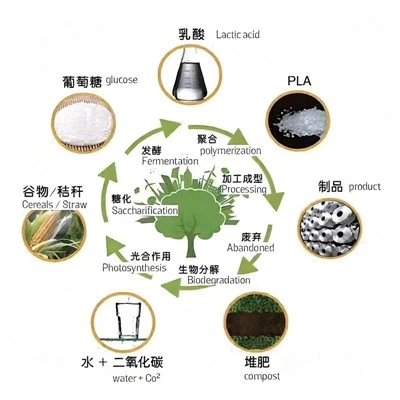
After disposal, microbial PHA depolymerases in soil, seawater, or compost hydrolyze the ester bonds of the fiber, reducing molecular weight until the fragments are metabolized into CO2 and water. This PHA fiber therefore degrades under far milder conditions than PLA or PBS, and enters the natural carbon cycle without needing an industrial compost facility.

Core Advantages
1) Broad-spectrum biodegradation. The fiber breaks down under microbial action in soil, seawater, home compost, and industrial compost. No high-temperature facility is required.
2) Fully bio-based. The resin comes from renewable plant sugars, and the carbon originates from the current atmospheric CO2 pool. The cradle-to-gate carbon footprint is 30% to 50% lower than petroleum-based PET.
3) Process-friendly. The resin is thermoplastic and feeds directly into standard polyester staple spinning lines without any organic solvent.
4) Biocompatibility. The polymer family is non-irritating to skin and tissue, and is already used for medical sutures, wound dressings, and tissue scaffolds.

Technical Specifications
|
Parameter |
Value |
|
Composition |
100% PHBV (P(3HB-co-3HV)) |
|
Fiber type |
Staple fiber |
|
Fineness |
1.5 - 6.0dtex |
|
Cut length |
32mm / 51mm |
|
Tenacity |
2.5 - 4.0 cN/dtex |
|
Elongation |
15 – 40% |
|
Cross-section |
Round / trilobal / cruciform / hollow |
|
Color |
Natural off-white / dope-dyed |
|
Crimp |
Mechanical crimp on request |
|
Packaging |
Standard bale ~250-300 kg |
Applications
1) Hygiene and personal care. Wipes, facial masks, and single-use hygiene top sheets, where the PHBV Staple Fiber decomposes in varied disposal environments.
2) Packaging and industrial uses. Biodegradable nonwoven bags, cushioning wraps, and geotextiles. 3) Apparel research. Blended with PLA, cotton, or wool for fully degradable fabrics.

Sustainability & Certifications

Global Standards & Audit
Working closely with international certifi ation bodies.
We cooperate with international certification bodies and independent third-party auditors to maintain full compliance with GRS, RCS and OEKO-TEX® Standard 100 requirements for our textile fiber materials.
GRS
Global Recycle Standard
RCS
Recycled Claim Standard
OEKO-TEX®
Standard 100
Shanghai Manufacturing Facility
Our Shanghai manufacturing facility operates under strict ISO 14001 environmental management and ISO 50001 energy manag!ement systems. Recognized as a National Green Factory, we are committed to sustainableig throughout ourproduction, energy efficiency, and low-carbon manufacturi throughout our operations.
ISO 14001
Environmental Mgt
ISO 50001
Energy Mgt System
National Gree
Factory Certified

Contact Us
For samples, technical data sheets, or bulk pricing of PHBV Staple Fiber, contact the Different sales team. Technical advisors will recommend the best-matched fineness and cut length for the end use. Support covers fiber selection through nonwoven or yarn-line adaptation.
Tell us About Your Needs
Different is a trusted manufacturer and long-term partner for your business. Please contact us by filling out the form below, we'll get in touch with you shortly to discuss your specific needs.
Hot Tags: phbv fiber, China phbv fiber manufacturers, suppliers, factory