
Shanghai Different Advanced Material Co., Ltd. is one of the leading manufacturers and suppliers of pbt staple fiber in China. With abundant experience, we are committed to providing high quality custom service for global clients. Welcome to wholesale premium pbt staple fiber made in China here from our factory.
High-Resilience PBT Staple Fiber
Flexible Stretch. Lasting Recovery. Soft Hand Feel.
Engineered for resilient performance, PBT staple fiber combines excellent recovery with a soft, comfortable touch.
It offers textile manufacturers a practical option for stretch fabrics and other applications requiring flexibility, durability, and shape retention.
Product Overview
Melt-spinning polybutylene terephthalate is the production route. Different runs it to make PBT staple fiber. A flexible butylene segment sits beside each aromatic ring, so the fiber keeps PET-type strength while its recovery comes close to nylon. Tensile and compressive recovery hold in dry and wet states. Humidity swings change little. The hand is soft, the crimp bulky. Abrasion and soil resistance are good. Ordinary disperse dyes give bright shades at atmospheric boiling. Fineness, cut length, crimp level, and luster are customizable for stretch apparel, wool-like and filling materials, tufted carpets, and brush filaments.
This staple takes the middle path between PET and spandex. Its recovery beats regular polyester and ranks just below elastane. It is also more lightfast than elastane and yellows less, so mills can partly replace spandex in stretch fabrics. For comfortable stretch at controlled cost, PBT fiber is a workable choice.
Technology Principle
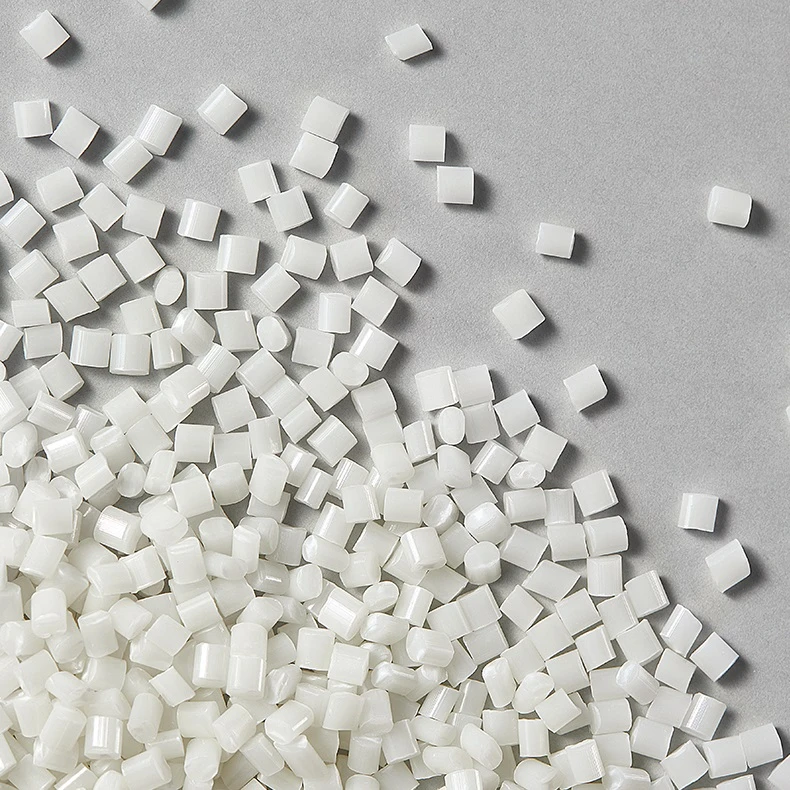
The polymer behind Different PBT fiber is made by esterifying and polycondensing purified terephthalic acid (PTA) or dimethyl terephthalate (DMT) with 1,4-butanediol (BDO). The resulting backbone carries four methylene units per repeat, giving a chain that is markedly more flexible and mobile than PET -- the structural origin of the fibers outstanding resilience. PBT crystallizes roughly ten times faster than PET, so spinning runs smoothly and the polymer chips dry without sticking, which supports stable, high-throughput production.
Under an applied strain the flexible PBT chains extend and slide freely; once the load is released they snap back quickly, producing excellent tensile and compressive recovery that holds in both wet and dry conditions and stays stable across changing ambient humidity and temperature. The tactile result is closer to nylon than to conventional polyester.
Because the glass-transition temperature of PBT sits near 22 C -- far below that of PET -- dye molecules penetrate the fiber at much lower temperatures. Ordinary disperse dyes therefore achieve deep, brilliant shades through atmospheric boiling around 100 C, with no high-pressure vessel and no carrier chemicals, cutting both energy use and dyeing cost while delivering good fastness and excellent chlorine resistance.

Core Advantages
Outstanding Elastic Recovery
PBT staple fiber delivers excellent recovery from both tensile and compressive strain -- clearly better than conventional PET and second only to spandex. The resilience holds in dry and wet states and stays consistent despite changes in ambient humidity and temperature. Compared with elastane, PBT is more lightfast, resists yellowing better, and offers higher strength, so it can partially replace spandex in stretch denim and activewear to reduce sagging and filament breakage after repeated wear and washing.
Low-Temperature Dyeing
Thanks to a glass-transition temperature near 22 C, the fiber absorbs disperse dyes at the boil under normal pressure with no carrier required. Shades come out bright and level, with good colorfastness and chlorine resistance, while dyeing cycles shorten and both energy use and effluent load drop noticeably.
Soft, Bulky, Wool-Like Hand
A low Youngs modulus and fine, well-developed crimp give PBT a warm, wool-like touch. It blends readily with cotton, linen, and viscose for autumn-winter fabrics, serves as down-like filling or washable thermal wadding, and can be co-spun with PET into bicomponent fibers with persistent three-dimensional crimp.
Durable and Soil-Resistant
Good resistance to chemicals, light, and heat, together with low critical surface tension and good wet-state dimensional stability, make PBT suitable for long-life home textiles -- carpets, curtains, bedding -- and automotive interior uses where soiling and wear are a concern.
Technical Specifications
|
Parameter |
Specification |
|
Product Name |
PBT staple fiber |
|
Composition |
100% polybutylene terephthalate (PBT) |
|
Fineness |
customizable (commonly 1.5D–15D) |
|
Cut Length |
customizable |
|
Tenacity |
approx. 3–4 cN/dtex |
|
Elongation at Break |
30%–60% |
|
Elastic Recovery |
superior to conventional PET |
|
Dyeability |
disperse dye at the boil, no carrier |
|
Packaging |
standard bale |
Applications
Solutions for Every Industry
The combination of elasticity, softness, and easy dyeing opens a wide range of end uses for PBT staple fiber.
Customers are invited to work with the Different technical team to finalize the PBT Fiber grade that best balances resilience, handle, and cost for each end use.

Active And Casual Wear
Sportswear, training tops, knit pullovers, and hosiery that stay vivid in color and keep their shape after repeated stretch;
01
Wool-like And Filling Products
Blended with cotton, linen, or viscose for autumn-winter wool-like fabrics, or processed into down-like filling and washable thermal wadding; bicomponent spinning with PET yields fine, crimped wool-like and down-like fibers;
02
Carpets And Home Textiles
Tufted carpets with a wool-like touch and strong pile recovery, plus curtains, bedding, and sofa covers where soil resistance and durability count;
03
Sustainability & Certifications

Global Standards & Audit
Working closely with international certifi ation bodies.
We cooperate with international certification bodies and independent third-party auditors to maintain full compliance with GRS, RCS and OEKO-TEX® Standard 100 requirements for our textile fiber materials.
GRS
Global Recycle Standard
RCS
Recycled Claim Standard
OEKO-TEX®
Standard 100
Shanghai Manufacturing Facility
Our Shanghai manufacturing facility operates under strict ISO 14001 environmental management and ISO 50001 energy manag!ement systems. Recognized as a National Green Factory, we are committed to sustainableig throughout ourproduction, energy efficiency, and low-carbon manufacturi throughout our operations.
ISO 14001
Environmental Mgt
ISO 50001
Energy Mgt System
National Gree
Factory Certified

Contact Us
For detailed technical data, sample testing, or bulk pricing of PBT staple fiber, please contact the Different sales team through the channels below. Our technical advisors will recommend the finest-matched fineness, cut length, and crimp specification based on your end use, elasticity target, and cost budget, and provide end-to-end support from fiber selection through spinning, weaving, and dyeing-finishing adaptation.
Tell us About Your Needs
Different is a trusted manufacturer and long-term partner for your business. Please contact us by filling out the form below, we'll get in touch with you shortly to discuss your specific needs.
Hot Tags: pbt staple fiber, China pbt staple fiber manufacturers, suppliers, factory